Order two booty bands both labeled “heavy,” and there is a good chance they will not feel the same in a hip thrust. One might bite hard from the first inch of stretch while the other eases in and never quite challenges your best lifters. Neither is defective. The uncomfortable truth for anyone building a custom band line is that “light,” “medium,” and “heavy” are marketing words, not measured specifications, and the number that actually matters — pounds of resistance at a given stretch — is set by the band’s dimensions and material, not by the label you print on the sleeve. Understanding that is the difference between a set that feels coherent from light to heavy and one that gets returned because the levels are all over the place.
There is no industry standard for “light, medium, heavy”
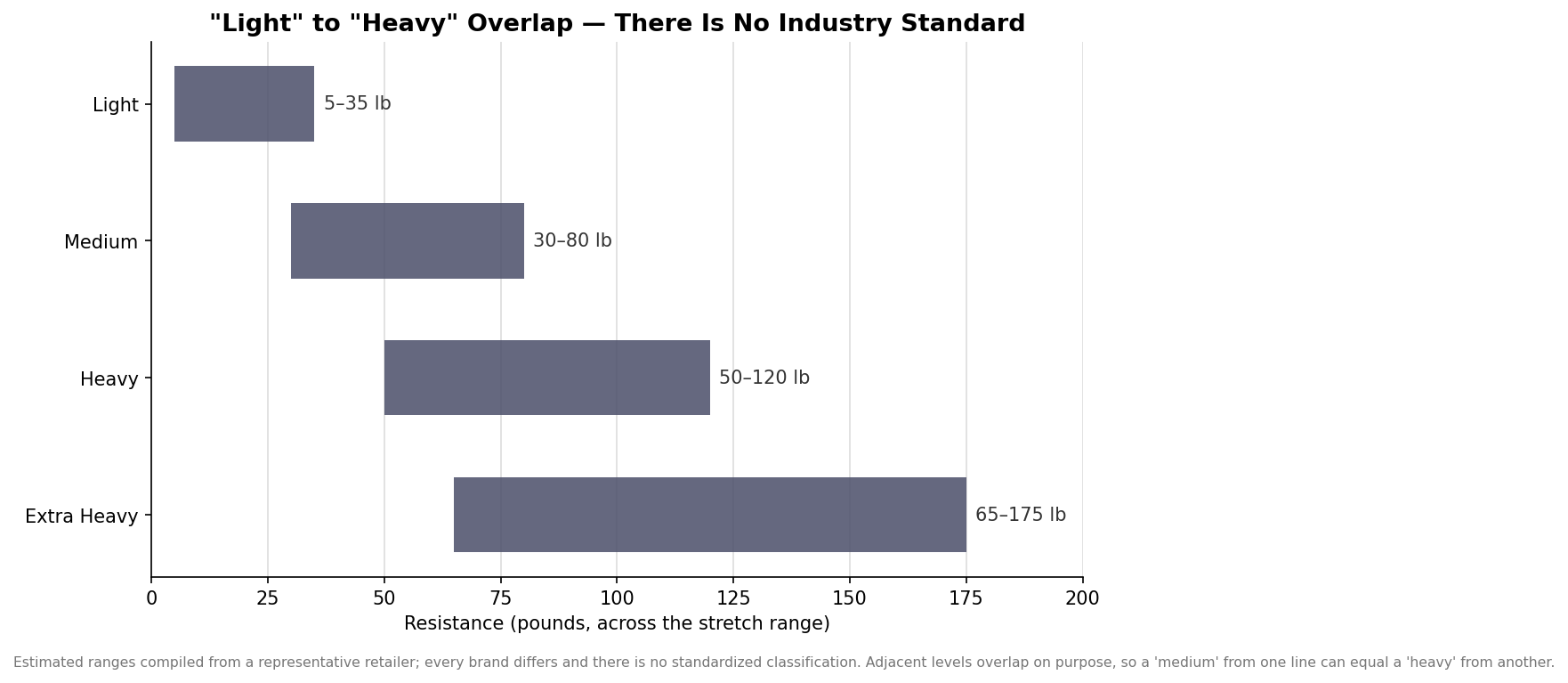
No governing body defines what those words mean. Retail guidance says so plainly: resistance labels and colors “vary between manufacturers,” and buyers are told to choose by the listed resistance range rather than the name on the band. The practical result is heavy overlap between adjacent levels. In one representative compilation, a “light” band spans roughly 5 to 35 pounds across its stretch, “medium” 30 to 80, “heavy” 50 to 120, and “extra heavy” 65 to 175 or more — ranges that step up but also collide, so the top of one factory’s “medium” can equal the bottom of another’s “heavy.” Fabric hip bands typically sit toward the lower end of those spans, but the lesson holds: if you specify a set by adjective alone, you are leaving the actual feel of your product to whatever the factory’s house scale happens to be.
What actually sets a fabric band’s resistance
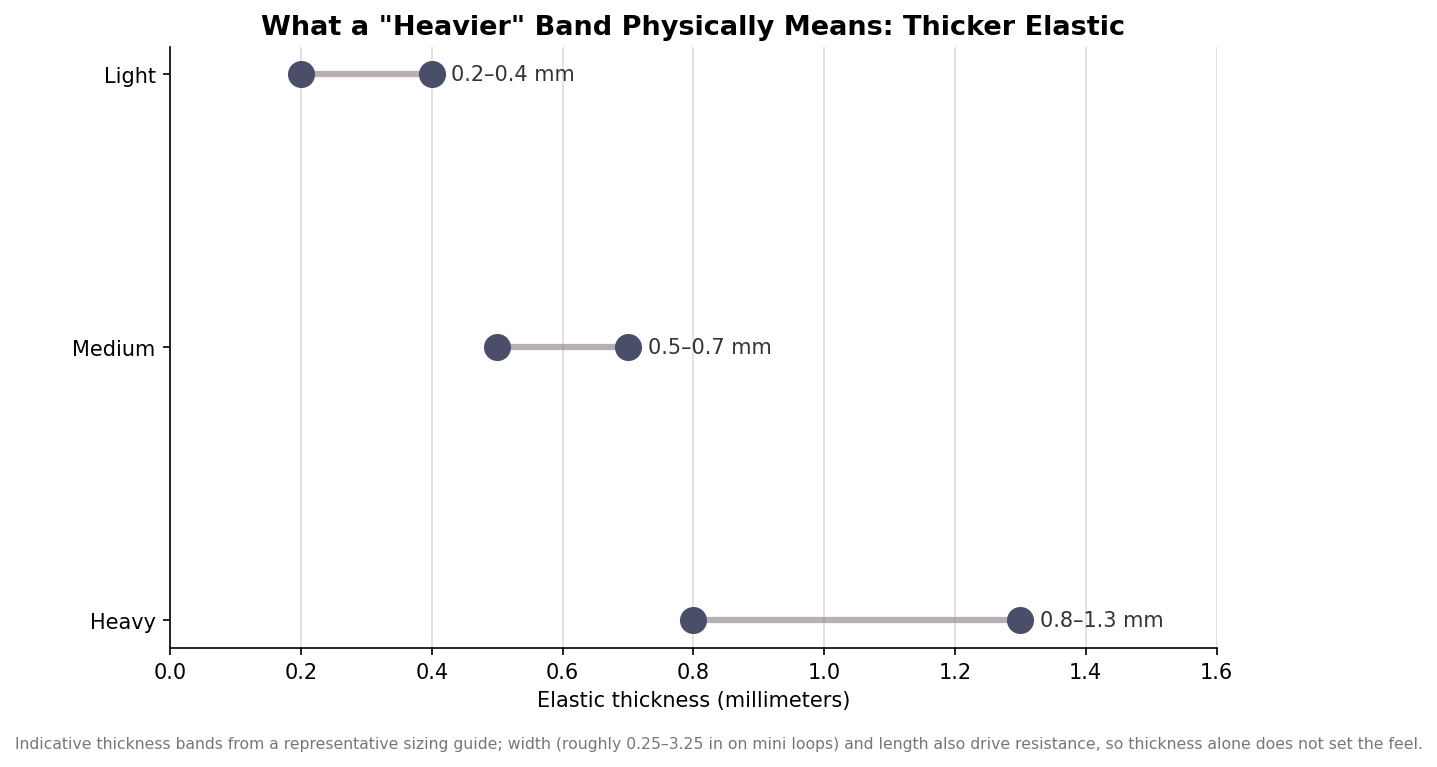
Four physical variables do the real work. Width is the biggest lever on a fabric mini loop: narrow bands around a quarter inch deliver only about 5 to 15 pounds, while very wide bands past three inches can reach 70 pounds or more at full stretch. Thickness of the elastic is the next lever — a representative sizing guide puts light bands near 0.2 to 0.4 mm, medium around 0.5 to 0.7 mm, and heavy roughly 0.8 to 1.3 mm — and thicker elastic also changes the feel, engaging more abruptly rather than easing in. Length (the loop’s unstretched circumference) sets how far the band is pre-tensioned when it goes around the thighs; a shorter loop on the same body starts under more tension. And the material and construction — the ratio of elastic to woven fabric, the quality of the internal rubber, and the stitching — determine how linear and how durable that resistance is. Change any one of these and the pound figure moves, which is exactly why two same-labeled bands can feel worlds apart.
Resistance is not one number — it climbs as the band stretches
A band does not have a single “weight” the way a dumbbell does. The force it applies rises the more it is stretched, so the resistance at the bottom of a squat, where the band is barely elongated, is far lower than at lockout, where it is pulled tight. This is why quoted ranges are ranges: the low end is light early stretch and the high end is near full extension. For programming, that progressive load is a feature for glute work, where you want peak tension at the top of the movement. But it also means the honest way to describe a band is by the pounds it produces at a defined stretch — say, at 100 percent elongation — not a single headline number. When you compare vendors or set your own tiers, insist on a stated test condition, or you are comparing figures measured in different ways.
How to specify a set that feels consistent
The fix is to stop specifying by adjective and start specifying by measurement. Define each level in your line by a target resistance at a stated stretch percentage, with a tolerance, and hold the factory to it — for example, a “medium” that pulls a defined number of pounds at full elongation, plus or minus a set margin. Then lock the dimensions that produce it: width, unstretched length, and elastic thickness, because those are what the factory can actually control on the sewing floor. Ask for a physical pull test on a sample using a hanging scale or a force gauge, and confirm the steps between your levels are even; a common mistake is a set where light to medium is a small jump and medium to heavy is a cliff. Even, measured spacing is what makes a set feel like a coherent system rather than three unrelated bands that happen to share a logo.
What this means when you order a branded line
If you are a gym, trainer, or fitness brand putting your name on a set, the label is your promise and the pounds are what your customers actually experience. Treat the resistance spec as the core of the product and the print as the finish, not the other way around. Give your manufacturer measured targets and tolerances, get pull-tested samples before you approve a bulk run, and keep the same test protocol across reorders so your “medium” a year from now still feels like this year’s. Document the width, length, and thickness that produced the approved feel so a future batch can be matched even if staff change. Done that way, your levels stay honest, your reviews stay kind, and the only thing customers notice about the label is your brand — not that the “heavy” felt suspiciously like everyone else’s medium.