The hardest part of ordering a custom booty band set is not the fabric or the logo, it is the tension. Resistance-level names are not standardized across manufacturers, so one supplier’s “medium” can pull noticeably harder or softer than another’s, and a set that looks complete on paper can feel like two bands doing the same job once it ships. If you are building a private-label line for a gym, a trainer, or a fitness brand, specifying the set well up front is what keeps returns down and reviews high. Here is how to define resistance, size, and construction so the bands you receive match the ones you designed.
Specify by tested force, not by the label word
Treat “light,” “medium,” and “heavy” as marketing labels, not measurements. Ask the manufacturer for the tested pull force of each band, ideally the load in pounds at a defined stretch such as the band elongated to a set percentage of its resting length. If the factory cannot give you a number, that is a signal to sample before you commit. The chart below shows the approximate force bands most makers cluster around, but the ranges overlap, which is exactly why the label alone is not enough to plan a set.
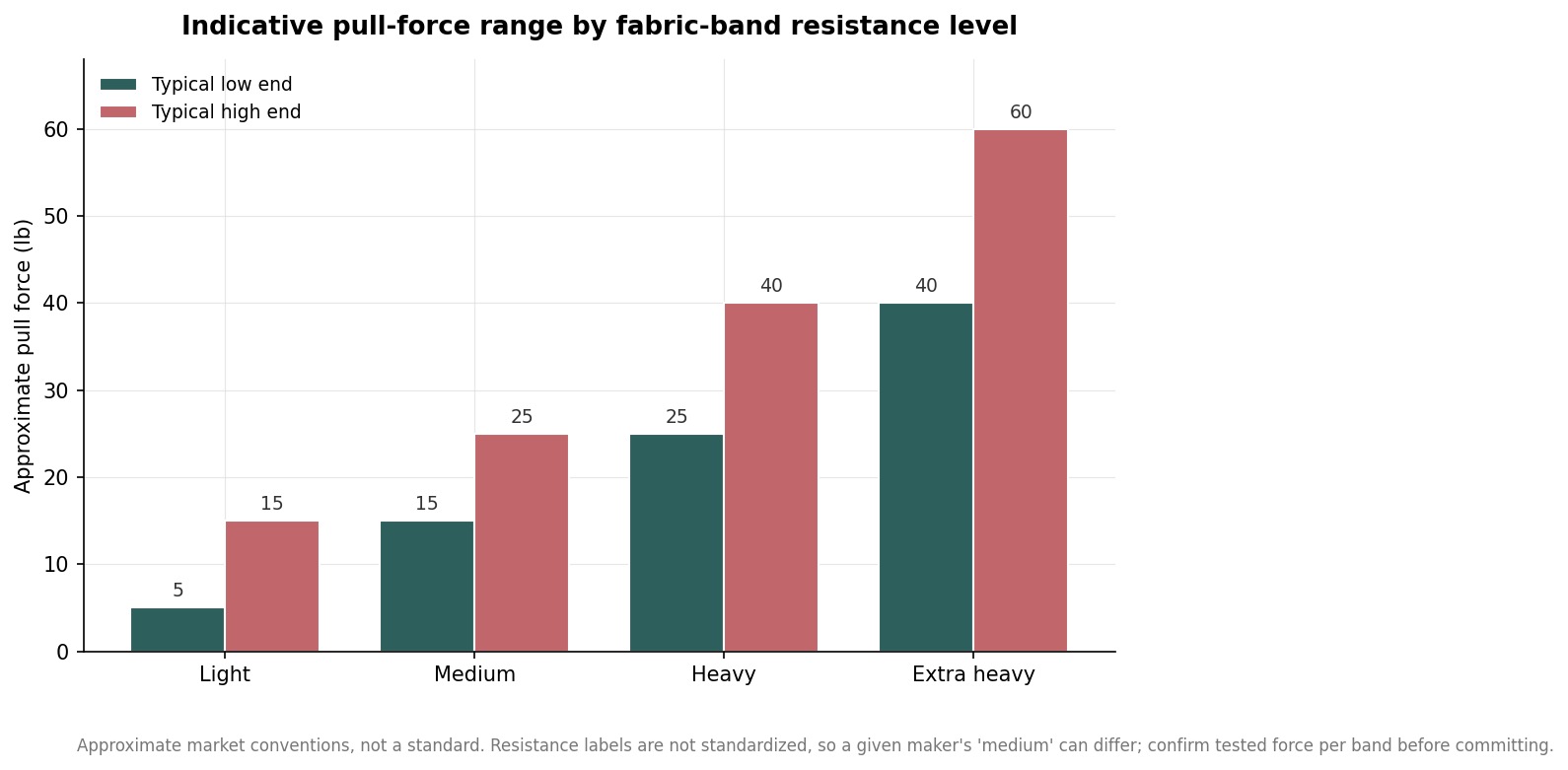
The practical rule is to define your own ladder in force terms and hold the factory to it. For a three-band set, a common approach is to place the levels roughly at the low, middle, and high end of the range your customer needs, leaving a clear gap between each so the steps feel distinct. When two adjacent bands land within a few pounds of each other, users cannot tell them apart, and the set feels padded rather than progressive.
Build a ladder with clean gaps
Decide the span before the steps. A set aimed at glute activation and warm-ups can live entirely in the lighter half of the range, while a set marketed for lower-body strength needs to reach into heavy and extra-heavy territory. Once you know the top and bottom, space the middle bands evenly in force rather than by name. A four-band set that runs roughly light, medium, heavy, and extra heavy covers most general-fitness use, but a specialist line might drop the lightest band and add a second heavy step instead. The point is to design the ladder around your customer’s actual movements, then translate it into force targets the factory can hit.
Match loop size to where the band sits
Fabric booty bands are wide loops, typically around three inches (about eight centimeters) tall, and they commonly come in a few flat lengths. A representative size range is 13 inches, 15 inches, and 17 inches flat, which corresponds to progressively larger loop circumferences. Size changes the effective tension as much as the resistance rating does. A shorter loop is pre-stretched more on the same person, so it feels firmer and tends to sit higher, above the knee or across the thighs, while a longer loop feels easier and suits placement around the ankles or larger limbs. If your customer base spans a wide range of body sizes, offering two loop lengths at the same resistance can do more for fit and reviews than adding another resistance level. Keep the band width consistent across the set; the wide face is what distributes pressure and stops the band from digging in during hip work.
Construction is what stops the roll and the snap
The failure modes buyers complain about most are rolling and snapping, and both come down to construction. A quality fabric band uses a woven outer face for grip and durability with an internal latex or elastic layer that provides the stretch; the stretch does not come from the fabric itself. Seams should be sewn rather than glued or fastened with hook-and-loop, because a sewn closure is what survives thousands of stretch cycles without peeling apart. A non-slip inner surface, whether a silicone grip pattern or a rubberized strip, is what keeps a wide band from rolling into a rope mid-set. Latex thickness in the stretch layer commonly falls somewhere in the fractional-millimeter to roughly one-millimeter range depending on the resistance, and thicker internal layers generally read as higher resistance and longer life. When you sample, stretch each band hard, look at the seams, and check whether the grip holds on bare skin and over leggings, since that is how it will actually be used.
Decoration and the order plan
Fabric bands take branding several ways, and the fabric face decides which. Screen printing and heat transfer put a logo on the woven surface economically and suit one- or two-color marks. Dye sublimation allows full-color, all-over patterns but generally requires a light polyester face to take the dye, so it is not an option on dark fabric or on the latex itself. A woven or printed care label sewn into the seam is a low-cost way to carry sizing and brand name without touching the band face. Match the method to the artwork early, because a design built for sublimation will not translate to a screen print without changes.
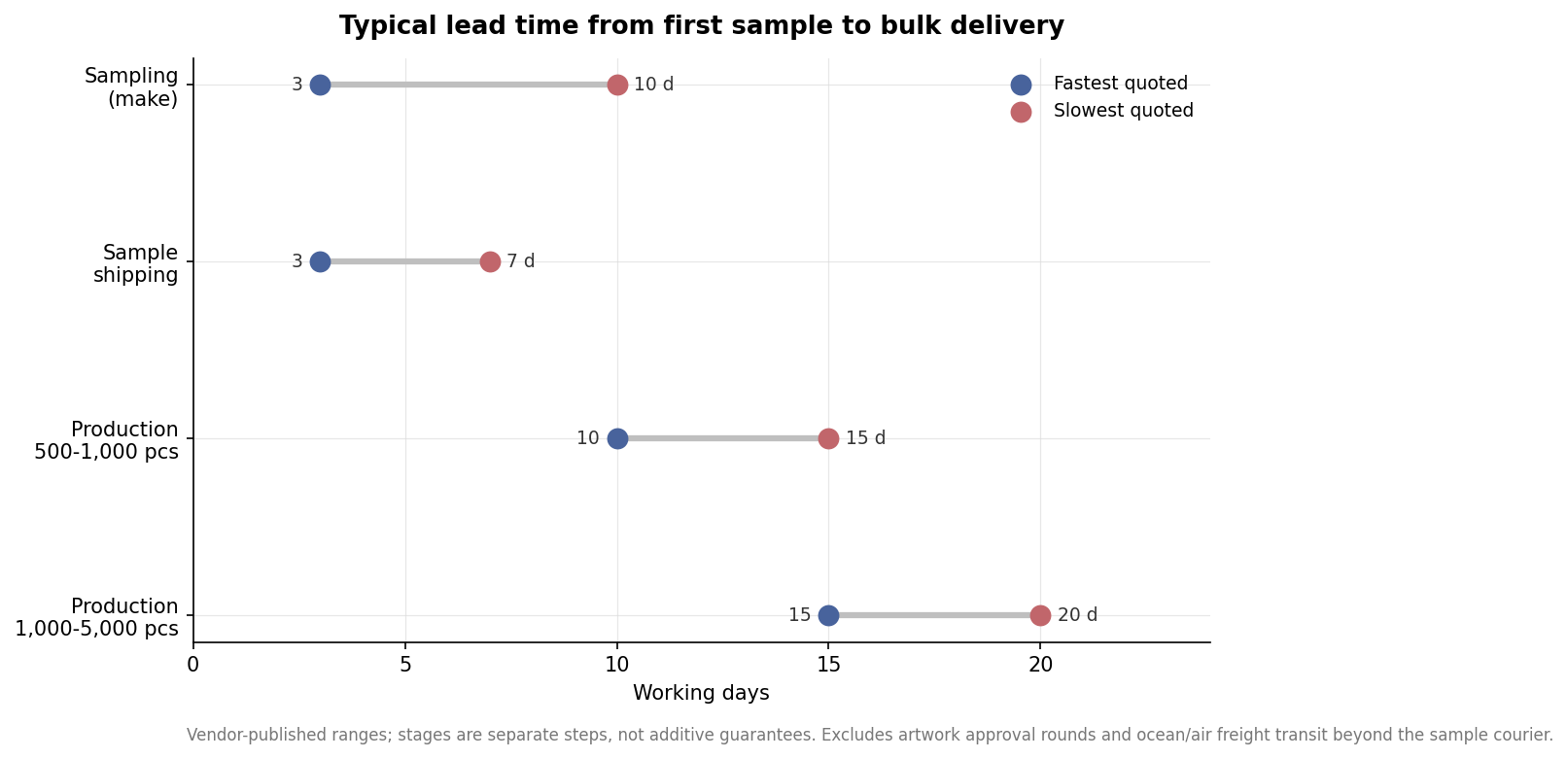
On quantities and timing, sampling usually runs a handful of pieces per design, trial orders commonly sit in the low hundreds, and standard production typically starts around 500 pieces, with per-unit cost falling as volume rises. Build your launch calendar backward from realistic lead times rather than best-case ones. The timeline below shows vendor-published ranges for each stage; note that these are separate steps and do not include artwork approval rounds or ocean freight, both of which can add weeks. Plan the sample round first, lock the tested force and construction on an approved sample, and only then commit the bulk order, so the set your customers receive is the one you specified.